Denarius of Julius Caesar

Denarius of Julius Caesar

This coin depicts Aeneas, a prince of Troy and legendary ancestor of Caesar. At the end of the Trojan War, Aeneas escaped Troy, carrying his elderly father and holding tight to his young son’s hand, settling on the coast of Italy, where his descendants would go...
Denarius of Marcus Junius Brutus

Denarius of Marcus Junius Brutus

According to Roman tradition, Lucius Junius Brutus became one of the first Consuls of Rome in 509 BCE after overthrowing its last king, Tarquinius Superbus. Centuries later, his descendant Marcus Junius Brutus (of “Et tu, Brute” fame) invoked this legendary act of...
Quinarius of Cato the Younger

Quinarius of Cato the Younger

Minted quickly by Cato to pay his soldiers as they battled Caesar’s forces in modern-day Tunisia, this small coin depicts the goddess Victory and the god Liber, powerful symbols of Roman hope and liberty. Despite this appeal to the gods, Cato and his forces could not...
Silver Tetradrachm of Ptolemy I

Silver Tetradrachm of Ptolemy I

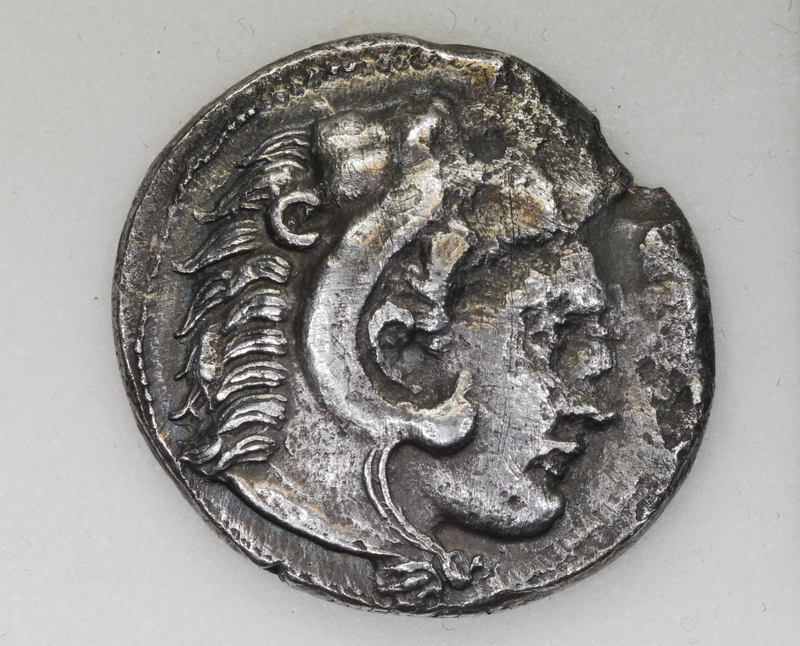
Coinage offered an effective means of circulating political messages to a broad population. This silver tetradrachm was minted in Egypt under Ptolemy I Soter. The obverse shows a portrait of Alexander the Great with an elephant-scalp cap, horns of Ammon, and aegis;...
Athenian Tetradrachm

Athenian Tetradrachm

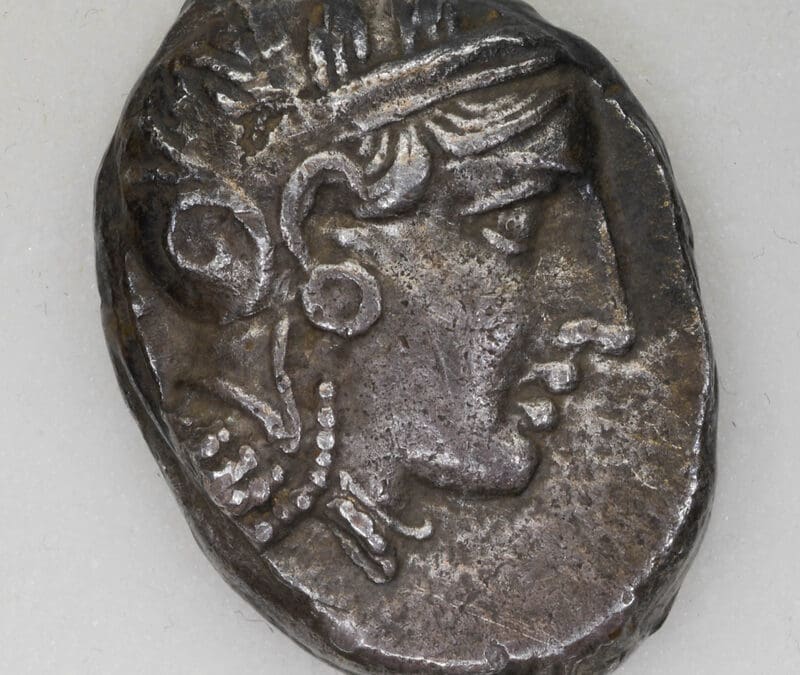
This silver coin is an Athenian tetradrachm, renowned as one of the most widely produced and recognized coins of the ancient world. Its obverse side features a striking depiction of Athena, the revered patron goddess of Athens, while the reverse showcases the owl, a...
Philip Arrhidaeus Tetradrachm

Philip Arrhidaeus Tetradrachm

This silver tetradrachm is a popular typology that was produced under the reign of Philip III Arrhidaeus, Alexander the Great’s half-brother. After the death of Alexander in 323 BCE, Philip III was chosen to be king, along with Alexander’s infant son named...